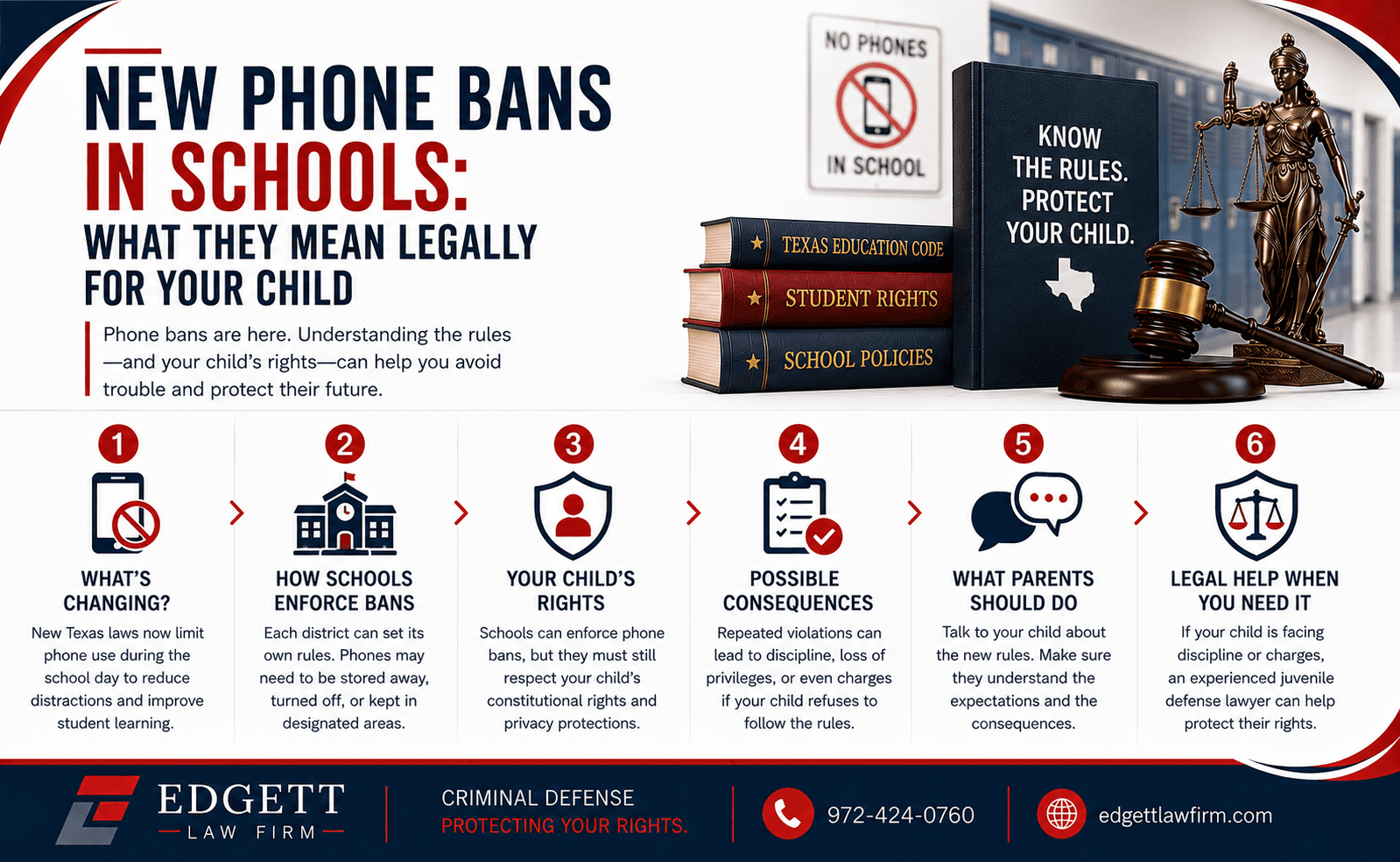
Every public school district and open-enrollment charter in Texas is now required to prohibit student use of personal communication devices during the school day. That is not a district choice any more.
Most of the coverage has treated this as a classroom management story. The part worth a parent's attention is narrower and more consequential: a policy that guarantees more phones will be confiscated also guarantees more moments where somebody decides whether to look inside one. Confiscation and search are different acts governed by different rules, and the gap between them is where families get into trouble.
What HB 1481 Requires
House Bill 1481, passed by the 89th Legislature and effective 1 September 2025, requires school boards to adopt and enforce a policy prohibiting students from using personal communication devices while on school property during the school day. Districts were required to have a policy in place by mid-September 2025.
The scope is wider than "no phones in class":
- The whole day. Instructional time, lunch, and passing periods, from first bell to dismissal.
- More than phones. Personal tablets and laptops, radio and paging devices, gaming devices, and wearable technology capable of digital or telecommunication, including smart watches, earbuds, wireless headphones, smart glasses, and fitness trackers.
- Exceptions exist. Documented medical need, provision in an individualized education program or Section 504 plan, and emergencies. Devices issued by the district are outside the restriction.
Enforcement details, including how devices are stored and what a repeat violation costs, are set by each district. Read your campus handbook, because that document is what will be applied to your child.
Confiscation Is Not a Search
This is the distinction that matters, and it is routinely blurred in practice.
A school taking temporary custody of a device under a written policy is enforcing a rule. Somebody opening that device and reading through it is conducting a search, and a search has to be justified.
Under New Jersey v. T.L.O., 469 U.S. 325 (1985), a school official needs neither a warrant nor probable cause, only reasonable suspicion. But the search must still be justified at its inception, meaning there are reasonable grounds to suspect it will turn up evidence of a rule or law violation, and reasonable in scope, meaning it is reasonably related to what prompted it and not excessively intrusive given the student's age, sex, and the seriousness of the suspected violation.
The scope prong does real work with phones. Suspicion that a student was texting during a test does not obviously justify scrolling a camera roll. A phone contains years of material that has nothing to do with the rule that was broken, and that mismatch is the argument.
When an Officer Gets Involved, the Standard Changes
A school resource officer is a peace officer. Where a search is conducted by or at the direction of law enforcement rather than by school staff acting on school concerns, the analysis shifts.
Under Riley v. California, 573 U.S. 373 (2014), police generally need a warrant to search the digital contents of a cell phone, even incident to a lawful arrest. The Supreme Court treated phones as categorically different from wallets and pockets because of the volume and nature of what they hold.
Which means the practical question in almost every one of these cases is the same: did somebody consent? A student who unlocks the phone when asked has supplied the access that the warrant requirement exists to protect. Teach your child that they can say, without rudeness, that they do not consent to their phone being searched and that they want their parent called.
What a Violation Actually Costs
A device violation is a discipline matter, not a criminal one. The route it takes runs through Chapter 37 of the Education Code and your district's student code of conduct.
That track was itself rewritten last year. House Bill 6, also from the 89th Legislature and effective for the 2025 to 2026 school year, expanded teacher authority to remove students from class, capped out-of-school suspension at three days and in-school suspension at ten, gave districts discretion to place a student in a disciplinary alternative education program for repeated and significant classroom disruption, and created a Virtual Expulsion Program for use where no Juvenile Justice Alternative Education Program placement is available.
Repeated device violations that get characterised as persistent disruption can therefore reach placement, not just detention. That is a meaningful change from two years ago.
What Parents Should Do Now
- Read the campus policy, not the news coverage. Storage method, escalation steps, and return procedure vary district to district.
- Get the exception documented if your child needs one. A medical need or an IEP or Section 504 provision has to be in writing before it is useful.
- Tell your child the phone can be taken but not necessarily read. Handing it over when a policy requires it is compliance. Unlocking it for someone to read is consent, and those are separate decisions.
- Ask what was viewed, and by whom. If the phone came back after being examined, find out who looked, what prompted it, and whether an officer was involved.
- Call a lawyer before a discipline hearing if anything was found. By that point the device question and a potential referral are the same problem.
What This Means for Your Family
The ban itself is a rule. The risk is downstream of it, in the moment a confiscated device becomes a source of evidence for something nobody was looking for. That is where a phone policy turns into a juvenile referral.
For what follows if a referral is made, see our guide to a child taken into custody at school, and our article on Texas sexting law for minors, which is the most common charge to come out of a searched phone. If your child's device was searched at a Collin or Denton County school and something came of it, our juvenile defense lawyers can review how the search was conducted. Contact us for a free consultation.
Frequently Asked Questions
What does Texas HB 1481 require schools to do about phones?
HB 1481, effective 1 September 2025, requires every public school district and open-enrollment charter school to adopt and enforce a policy prohibiting student use of personal communication devices while on school property during the school day. It covers phones, personal tablets and laptops, gaming devices, and wearables such as smart watches, earbuds, and smart glasses, and applies through instruction, lunch, and passing periods.
Can a Texas school search my child's phone after confiscating it?
Confiscation and search are separate acts. Taking the device under a written policy is rule enforcement. Reading it is a search, which under New Jersey v. T.L.O. requires reasonable suspicion and must be reasonably related in scope to what prompted it and not excessively intrusive. Suspicion of one rule violation does not automatically justify examining unrelated content.
Does a school resource officer need a warrant to search a student's phone?
Where a search is conducted by or at the direction of law enforcement, Riley v. California, 573 U.S. 373 (2014), holds that police generally need a warrant to search the digital contents of a cell phone, even incident to a lawful arrest. Consent removes that requirement, which is why a student who unlocks a phone on request gives up the protection.
Are there exceptions to the Texas school phone ban?
Yes. The law provides for documented medical need, provisions contained in an individualized education program or Section 504 plan, and emergencies. Devices purchased and issued by the school district are not covered by the restriction. Exceptions should be documented in writing with the campus before they are needed.
What is the punishment for a phone violation in a Texas school?
It is handled as school discipline under Chapter 37 of the Education Code and the district's student code of conduct, not as a criminal offense. Under HB 6, effective for the 2025 to 2026 school year, out-of-school suspension is capped at three days and in-school suspension at ten, and districts have discretion to place a student in a disciplinary alternative education program for repeated and significant classroom disruption.