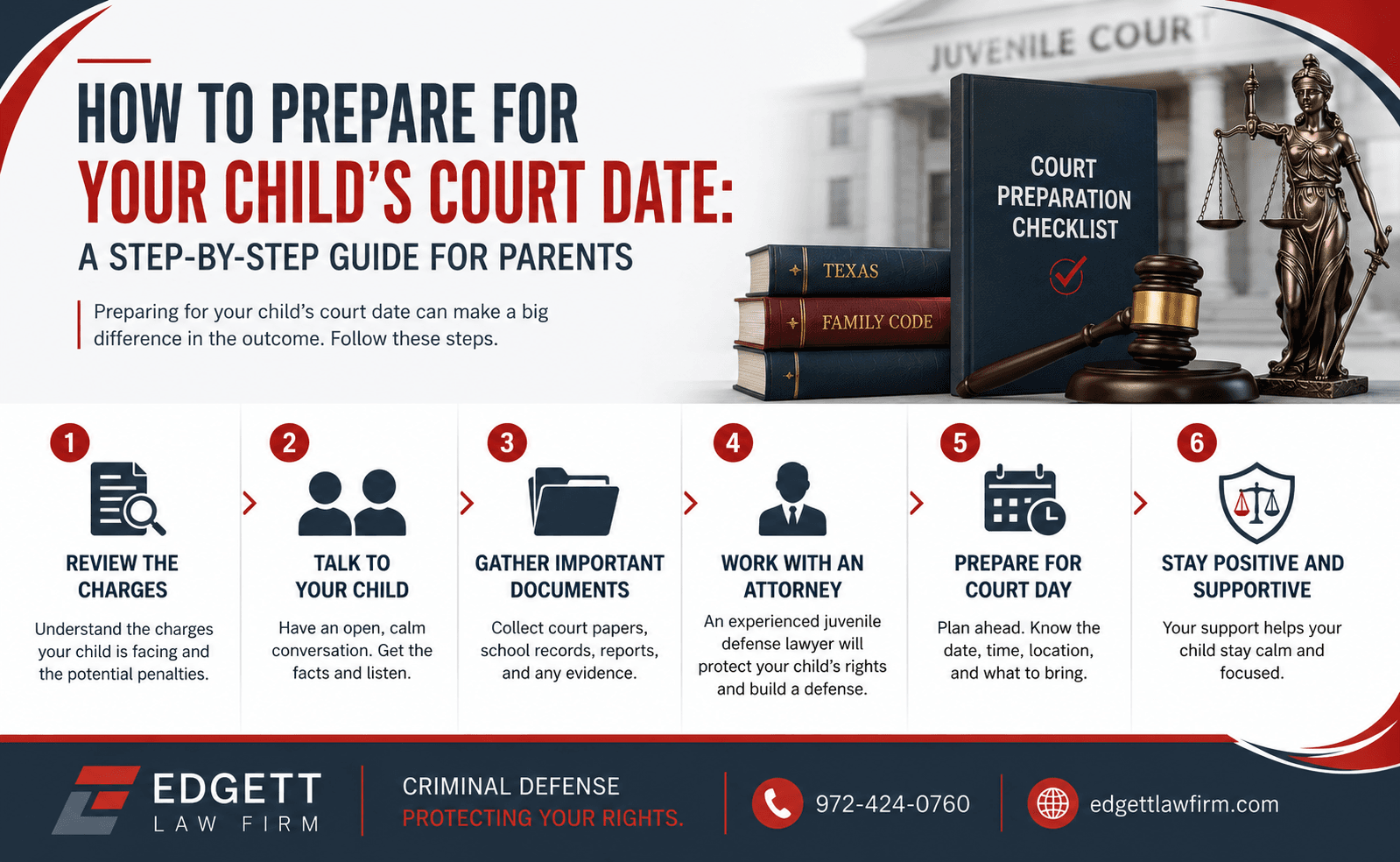
This guide is about the preparation rather than the proceeding. For what actually happens once the case is called, who speaks, and in what order, see our companion article on your child's first court appearance.
What follows is the week before, the paperwork, the conversation nobody knows how to start, and the obligations that fall on you rather than your child.
Your Attendance Is Required by Statute
Parents are often surprised that this is a legal duty rather than an expectation.
Section 51.115 of the Family Code requires each parent of a child, each managing and possessory conservator, each court-appointed custodian, and a guardian of the person of the child to attend each hearing. It applies to hearings on waiver of jurisdiction and discretionary transfer, adjudication, disposition, modification of disposition, and release or transfer.
If a person who received proper notice fails to attend, the court may proceed with the hearing anyway, and may punish the failure by a fine of not less than $100 and not more than $1,000, or instead order counselling or educational courses on parental responsibilities.
Exceptions exist for a person whose attendance the court waives for good cause, non-residents of Texas, and a parent who is not a conservator where another managing conservator has been appointed. If you cannot attend, the time to raise it is in advance, with the court, in writing.
The Week Before
- Confirm the setting. Date, time, courtroom, and floor. Juvenile settings are moved more often than most, and confirmation should come from your lawyer's office rather than a notice posted weeks ago.
- Ask what kind of hearing it is. A detention hearing, a plea setting, an adjudication, and a disposition are entirely different events. Prepare for the one you are attending.
- Gather documents. See the list below. Assemble them early enough that your lawyer can decide what is useful, which is not the same as bringing everything.
- Arrange the logistics. Time off work, care for other children, transport. A parent arriving stressed and late is a worse witness to their own family's stability.
- Meet your lawyer before the day. A conversation in a courthouse corridor is not preparation.
What to Bring
- Any court paperwork, conditions of release, and the notice of hearing
- School records: attendance, current grades, and any disciplinary documentation
- Proof of counselling, treatment, or programme enrolment, with dates and attendance
- Community service verification, if any has been completed
- Documentation of restitution paid or offered
- Medical, IEP, or Section 504 documentation where relevant to how your child functions
- A written list of questions, because you will not remember them
Progress that predates the hearing carries more weight than promises made during it. Counselling begun voluntarily two months ago is evidence. Counselling proposed at the hearing is a plan.
The Conversation With Your Child
Anxiety in a teenager reads as indifference from a bench. A child who has been told nothing arrives braced for a sentence and presents as either frozen or flippant. Neither helps.
Explain, in plain terms, what the hearing is and what it is not. Tell them who will be present. Tell them their lawyer speaks for them, and that they should answer only what they are asked, directly, without embellishment. Practise the likely questions out loud, because hearing your own voice answer once removes a great deal of the panic.
What not to do: do not rehearse a story, and do not tell your child what to say about the facts. Coaching is detectable, and it converts a manageable case into a credibility problem.
The Day Itself
- Arrive early. Thirty minutes. Security queues, parking, and finding the right floor all take longer than expected.
- Dress as you would for a job interview. Not a costume. Clean, plain, and covered. No slogans, no hats.
- Phones off. Not silent. Off. Some courts confiscate.
- Bring nothing your child does not need. Courthouse security is airport security.
- Sit where your lawyer tells you. Do not speak to the prosecutor, the complainant, or their family. Not to be polite, not to apologise, not at all.
- Let the hearing happen. If you are asked to speak, answer the question asked and stop.
- Take notes afterwards. Dates, conditions, and the next setting. You will not retain them otherwise.
Two Things Parents Get Wrong
Talking to the other family. The impulse is decent and the consequence is not. Contact can breach a condition of release, and anything said becomes evidence. Route everything through counsel.
Treating a plea setting as the end. Whether the case resolves with an adjudication or through deferred prosecution under Section 53.03 has consequences that surface years later, when the automatic record restriction under Section 58.253 either is or is not available. Do not agree to anything on the day without understanding which of those you are choosing.
What This Means for Your Family
Preparation is not about performing contrition. It is about arriving with the documentation that supports the outcome you are asking for, a child who understands what is happening, and a clear position agreed with your lawyer beforehand. Families that do those three things get better results than families that do not, consistently.
For orientation to the system, see our parent's guide to the Texas juvenile justice system. If your child has a setting coming up in Collin or Denton County, our juvenile defense lawyers can prepare the hearing with you. Contact us for a free consultation.
Frequently Asked Questions
Do parents have to attend juvenile court in Texas?
Yes. Family Code Section 51.115 requires each parent, managing and possessory conservator, court-appointed custodian, and guardian of the person of the child to attend hearings on discretionary transfer, adjudication, disposition, modification of disposition, and release or transfer. Exceptions apply where the court waives attendance for good cause, for non-residents of Texas, and for a parent who is not a conservator where another managing conservator has been appointed.
What happens if a parent misses a juvenile court hearing in Texas?
The court may proceed with the hearing despite the absence, and may punish a person who received proper notice and failed to attend by a fine of not less than $100 and not more than $1,000. Instead of a fine, the court may order the person to attend counselling or educational courses on parental responsibilities.
What should my child wear to juvenile court in Texas?
Clean, plain, covered clothing of the kind you would wear to a job interview. No slogans, no hats, nothing torn. Phones should be switched off rather than silenced, and you should bring nothing through security that is not needed, since courthouse screening is comparable to airport screening.
What should I bring to my child's juvenile court date?
All court paperwork and conditions of release, school attendance and grade records, any disciplinary documentation, proof of counselling or programme enrolment with dates, community service verification, documentation of restitution paid or offered, relevant medical or IEP documentation, and a written list of your questions. Progress that began before the hearing carries more weight than plans announced during it.
Should I talk to the other family at my child's court date?
No. Contact may breach a condition of release, and anything said, including an apology, can be treated as an admission and used later. Route all communication through your lawyer.