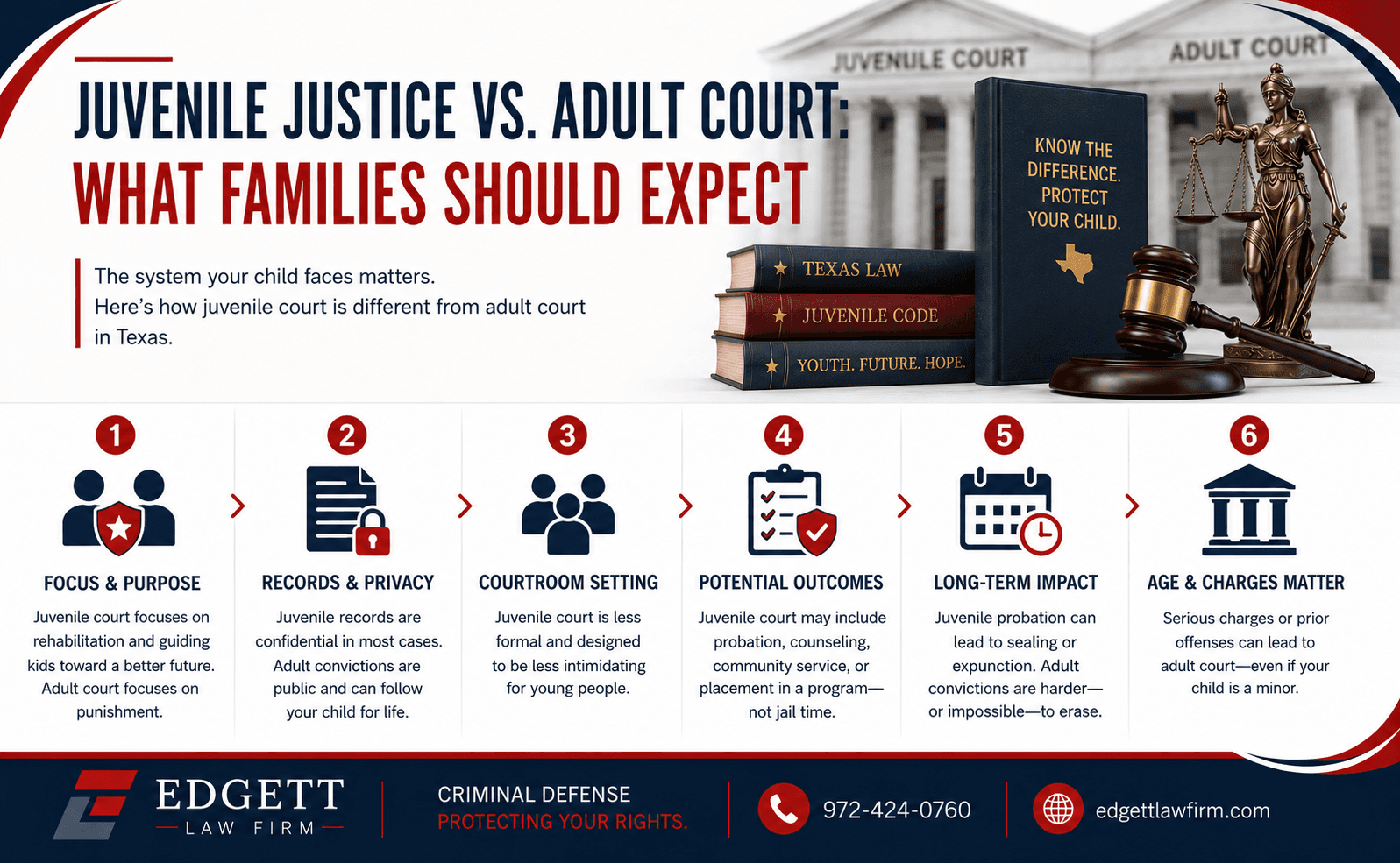
Families arrive with a reasonable assumption: juvenile court is adult court, scaled down. It is not. The two operate under different codes with different stated purposes, different vocabulary, and materially different consequences.
Knowing which system you are in, and whether there is any realistic prospect of moving between them, is the frame for every decision that follows.
Two Systems, Side by Side
| Juvenile court | Adult criminal court | |
| Governing law | Title 3, Texas Family Code | Penal Code and Code of Criminal Procedure |
| Who it covers | Age 10 to under 17 at the time of the conduct | 17 and older, or a transferred child |
| What the conduct is called | Delinquent conduct | A criminal offense |
| Nature of the case | Civil in form, with a rehabilitative purpose | Criminal |
| The finding | Adjudication | Conviction |
| The outcome | Disposition, including probation or commitment | Sentence |
| Records | Restricted or sealed under a statutory scheme | Public unless a separate remedy applies |
The proof standard is the same in both. Delinquent conduct must be proved beyond a reasonable doubt at adjudication, and a child has the right to a jury on that question. What differs is everything downstream of the finding.
The Bridge Between Them
A child can be moved from the first column to the second. The mechanism is discretionary transfer, sometimes called certification, under Section 54.02 of the Family Code, and it is a decision made by the juvenile court after a hearing.
The thresholds are specific:
- Age 14 or older at the time of the alleged offense, where the offense is a capital felony, an aggravated controlled substance felony, or a felony of the first degree.
- Age 15 or older at the time of the alleged offense, where the offense is a felony of the second or third degree or a state jail felony.
Below those ages and grades, transfer is not available at all. That single fact resolves a great deal of the fear families arrive with.
What the Court Weighs
Under Section 54.02(f), the court must consider, among other matters, whether the alleged offense was against person or property, with greater weight in favour of transfer given to offenses against the person; the sophistication and maturity of the child; the record and previous history of the child; and the prospects of adequate protection of the public and the likelihood of the rehabilitation of the child by use of the procedures, services, and facilities currently available to the juvenile court.
That fourth factor is where transfer hearings are genuinely fought. It asks whether the juvenile system can still do its job for this child, and it is answered with evidence: psychological evaluation, treatment history, school records, family circumstances, and what services are actually available. It is an evidentiary contest, not a formality, and it deserves preparation on the scale of a trial.
Our article on what "tried as an adult" means in Texas juvenile law covers the mechanics in more detail, and defense considerations for juveniles tried as adults deals with what changes once transfer happens.
The Middle Path Most Families Have Not Heard Of
Transfer is not the only route by which a serious juvenile case reaches beyond the juvenile system.
Determinate sentencing allows a prosecutor, for a defined list of serious offenses and with grand jury approval, to seek a sentence of a fixed number of years that can begin in the juvenile system and continue into adult custody. The case stays in juvenile court, the child keeps the procedural protections of that system, but the sentence is not capped at the child's 19th birthday the way an ordinary juvenile disposition is.
It matters because it is often the alternative on the table when transfer is being discussed. A family that understands only two options may not recognise the third when it is offered.
What Stays the Same
Some protections do not vary between the systems, and they are worth knowing.
Under Section 51.10, a child may be represented by an attorney at every stage of a juvenile proceeding, and that right cannot be waived at a transfer hearing, an adjudication hearing, a disposition hearing, or a hearing before commitment. Under Section 51.095, the restrictions on the admissibility of a child's statement apply in juvenile court, and they are stricter than the corresponding adult rules. Under Section 51.115, parents are required to attend the hearings, which is a duty rather than an option.
What This Means for Your Family
For the substantial majority of juvenile cases, transfer is not legally available and the real questions are earlier and more practical: whether the case can be resolved without an adjudication through deferred prosecution, and what the record looks like at 19.
Where transfer is available, the hearing is the most consequential day in the case, and it happens early. For an orientation to the system as a whole, see our parent's guide to the Texas juvenile justice system.
If your child is facing a serious allegation in Collin or Denton County, our juvenile defense lawyers handle transfer hearings and determinate sentencing cases. Contact us for a free consultation.
Frequently Asked Questions
At what age can a child be tried as an adult in Texas?
Under Family Code Section 54.02, discretionary transfer to criminal court is available from age 14 at the time of the alleged offense where the offense is a capital felony, an aggravated controlled substance felony, or a first-degree felony, and from age 15 where the offense is a second or third-degree felony or a state jail felony. Below those thresholds transfer is not available.
What is the difference between adjudication and conviction in Texas?
Adjudication is the finding made in juvenile court that a child engaged in delinquent conduct, and it is followed by a disposition rather than a sentence. A conviction is the finding in adult criminal court, followed by a sentence. Both require proof beyond a reasonable doubt, but the consequences, the record treatment, and the available outcomes differ substantially.
What does a Texas court consider when deciding to transfer a juvenile to adult court?
Section 54.02(f) requires the court to consider, among other matters, whether the alleged offense was against person or property with greater weight given to offenses against the person, the sophistication and maturity of the child, the record and previous history of the child, and the prospects of adequate protection of the public and the likelihood of rehabilitation using the procedures, services, and facilities currently available to the juvenile court.
What is determinate sentencing in Texas juvenile court?
It allows a prosecutor, for a defined list of serious offenses and with grand jury approval, to seek a sentence for a fixed number of years that can begin in the juvenile system and continue into adult custody. The case remains in juvenile court with its procedural protections, but the sentence is not limited to the child's 19th birthday as an ordinary disposition would be.
Does a child have the right to a jury in Texas juvenile court?
Yes, at the adjudication stage. Delinquent conduct must be proved beyond a reasonable doubt, the same standard as adult criminal court, and a child has the right to a jury on that question. Family Code Section 51.10 also gives a child the right to an attorney at every stage, and that right cannot be waived at transfer, adjudication, disposition, or pre-commitment hearings.