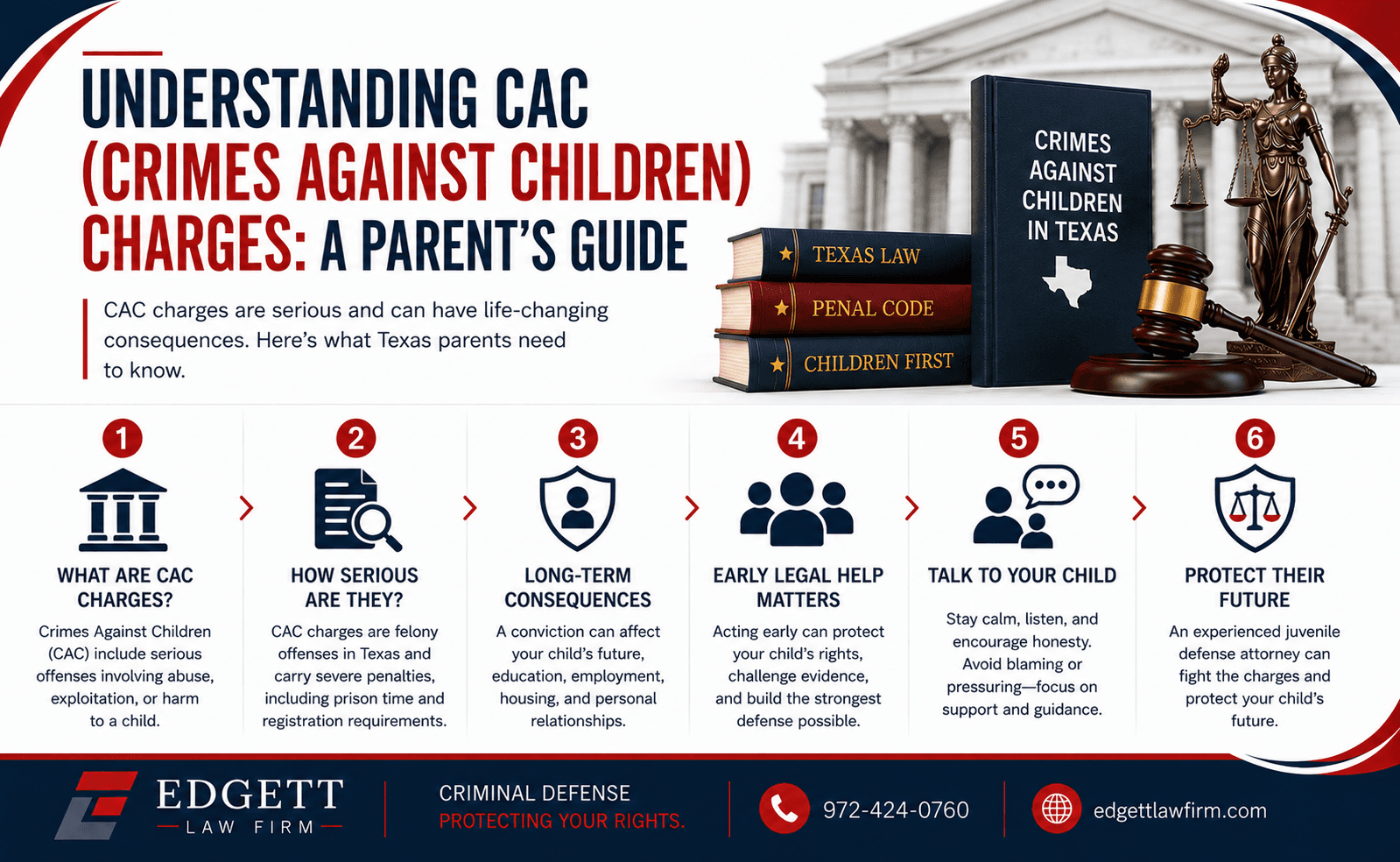
The acronym usually arrives before the explanation. A detective mentions the CAC unit. A bond hearing references a CAC docket. Nobody stops to say what it means.
Crimes Against Children is a category, not a charge. Prosecutors' offices and police departments group these cases into specialised units because they share investigative methods, not because they share elements or punishment. Within that category, the range runs from a state jail felony to a first-degree felony carrying a mandatory minimum of 25 years without parole eligibility. The first useful thing any family can do is find out precisely which statute is on the paperwork.
The Offenses That Fall Under the Heading
| Offense | Statute | Grade |
| Indecency with a child by contact | Penal Code 21.11(a)(1) | Second-degree felony |
| Indecency with a child by exposure | Penal Code 21.11(a)(2) | Third-degree felony |
| Sexual assault of a child | Penal Code 22.011(a)(2) | Second-degree felony |
| Aggravated sexual assault of a child | Penal Code 22.021 | First-degree felony, 25-year minimum in defined circumstances |
| Continuous sexual abuse of a young child | Penal Code 21.02 | First-degree felony, 25 to 99 years or life, not probatable |
| Possession or promotion of child pornography | Penal Code 43.26 | Third-degree felony and upward |
| Obscene material appearing to depict a child | Penal Code 43.235 | State jail felony and upward |
Three of those deserve a closer look, because they are the ones that most often surprise families.
Continuous Sexual Abuse
Section 21.02 was created as part of Jessica's Law in 2007. It requires the State to allege two or more acts of sexual abuse committed over a period of 30 days or longer. The punishment is 25 to 99 years or life, and because only sentences of ten years or less can be probated in Texas, probation is not available on a conviction.
The structural feature that makes it distinct is that the jury does not have to agree on which specific acts occurred, only that two or more occurred during the period. That is a significant difference from how most criminal charges are proved.
Aggravated Sexual Assault of a Child
Section 22.021 is a first-degree felony. The minimum term rises to 25 years where the complainant was younger than six, or younger than 14 with certain aggravating circumstances alleged. Aggravation can come from serious bodily injury, a threat of death or serious injury, use of a deadly weapon, administering an incapacitating substance, or simply the complainant's age.
Indecency by Contact
Section 21.11 is the charge most often misunderstood as minor because the word "indecency" sounds lesser than "assault". Contact is a second-degree felony carrying two to twenty years, and it is a registrable offense.
The Consequences That Outlast the Sentence
Most of these offenses are reportable under Chapter 62 of the Code of Criminal Procedure, the sex offender registration program. Registration is not part of the sentence in the ordinary sense. It is a separate, long-running set of obligations governing where a person may live, work, and be present, and it frequently constrains a family's life more than the criminal disposition does.
A limited exemption route exists for a narrow set of age-based cases. Article 62.301 allows a person to petition for exemption where the offense was indecency with a child or sexual assault, the actor was not more than four years older than the complainant, the complainant was at least 15, and the conviction rests solely on the ages of the parties. We cover that in our article on the Texas Romeo and Juliet law.
How These Cases Are Actually Investigated
The methods are consistent across jurisdictions, and knowing them tells you where the pressure points are.
- The forensic interview. Conducted at a children's advocacy center, recorded, and structured. It becomes a central piece of evidence and its methodology is examinable.
- Outcry testimony. Texas allows the first adult to whom a child described the abuse to testify about what was said, subject to statutory requirements. Who that person was, and precisely when, matters enormously.
- Delayed reporting. Common in this category, and the reasons for a delay are contested ground rather than automatically damaging to either side.
- Digital evidence. Devices, cloud accounts, and message history, usually obtained by warrant or by consent that nobody had to give.
- Parallel CPS involvement. A civil investigation running alongside, sharing information, with its own timeline. See our overview of CPS investigations in Texas.
When the Accused Is a Juvenile
A substantial share of these allegations involve one minor and another. Those cases begin in juvenile court, where the framework is rehabilitative, but they can be moved to adult court by discretionary transfer under Family Code Section 54.02 where the age and offense thresholds are met. Our articles on juvenile court compared with adult court and juvenile sex crimes in Texas deal with that path.
What This Means for Your Family
The single most consequential variable in this category is which statute is charged, because the difference between Section 21.11 and Section 21.02 is the difference between a probation-eligible range and a mandatory 25 years. Charging decisions in these cases are made early, are influenced by the investigative file, and are considerably harder to move once a grand jury has acted.
If you or a family member is under investigation in Collin or Denton County, our sex crimes defense lawyers handle these cases from the pre-charge stage. Contact us for a free consultation.
Frequently Asked Questions
What does CAC stand for in a Texas criminal case?
Crimes Against Children. It is an investigative and prosecutorial category rather than a single charge, covering offenses including indecency with a child, sexual assault and aggravated sexual assault of a child, continuous sexual abuse of a young child, and child pornography offenses. The punishment ranges differ enormously between them.
What is the punishment for continuous sexual abuse of a child in Texas?
Penal Code Section 21.02 is a first-degree felony punishable by 25 to 99 years or life. Because only sentences of ten years or less may be probated in Texas, probation is not available on a conviction. The State must allege two or more acts of sexual abuse committed over a period of 30 days or longer.
Is indecency with a child a felony in Texas?
Yes. Under Penal Code Section 21.11, indecency with a child by sexual contact is a second-degree felony, and indecency by exposure is a third-degree felony. Both are reportable offenses under the sex offender registration program in Chapter 62 of the Code of Criminal Procedure.
Does a crimes against children conviction require sex offender registration in Texas?
Most of these offenses are reportable convictions under Chapter 62 of the Code of Criminal Procedure. A narrow exemption route exists under Article 62.301 for certain age-based cases where the actor was not more than four years older than the complainant, the complainant was at least 15, and the conviction rests solely on the ages of the parties.
What is a forensic interview in a Texas child abuse case?
A recorded, structured interview of the child conducted at a children's advocacy center by a trained interviewer, usually early in the investigation. It commonly becomes central evidence in the case, and the interview methodology, the questions used, and any prior conversations the child had before it are all subject to examination.
Can a juvenile be charged with a crimes against children offense in Texas?
Yes. Many of these allegations involve one minor and another, and they begin in juvenile court under the Family Code. Depending on the offense grade and the child's age, the case can be moved to adult criminal court by discretionary transfer under Family Code Section 54.02.