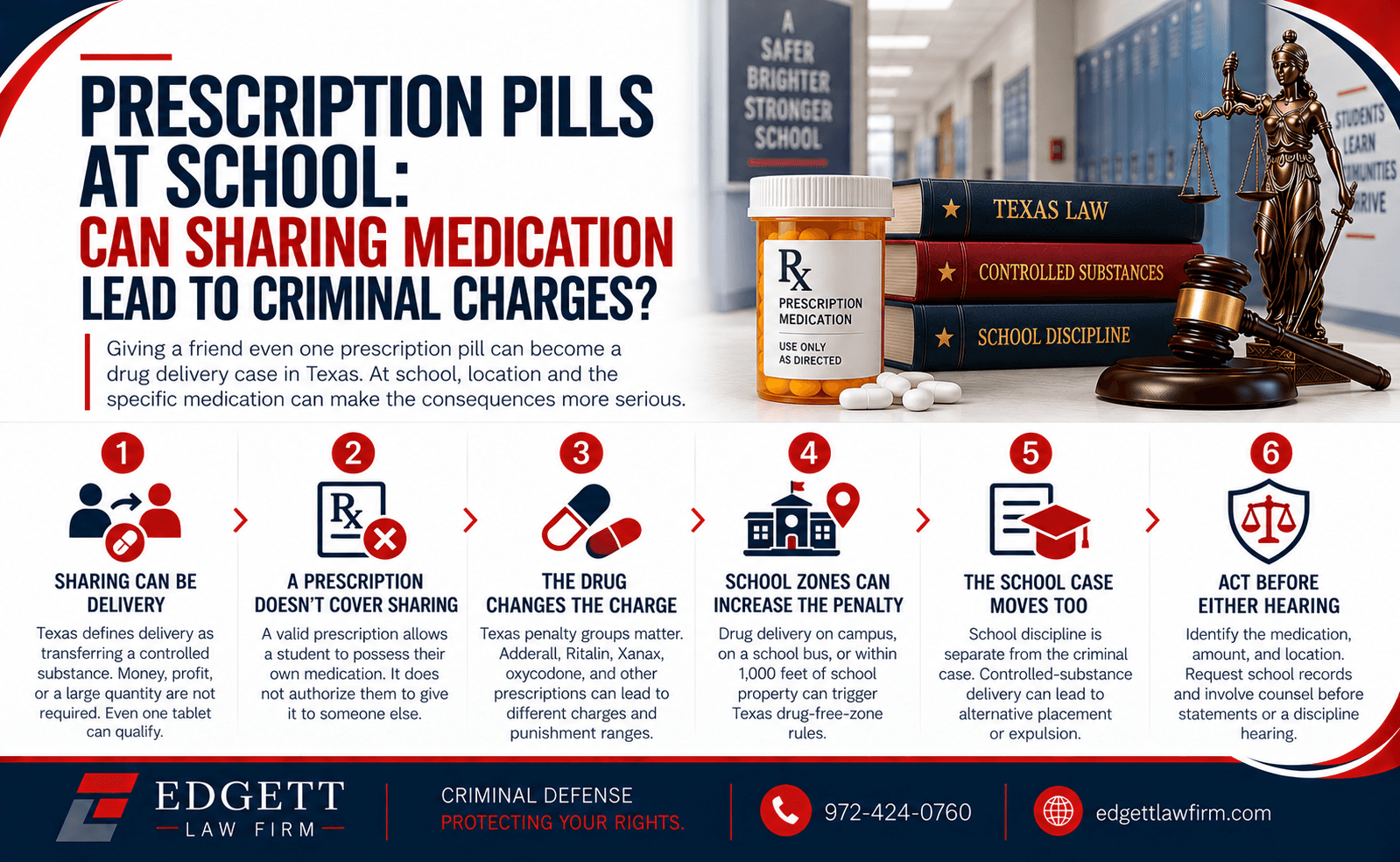
A student hands a friend one Adderall before a test. No money changes hands, there is no arrangement, and nobody is trying to hurt anyone. Under Texas law that is not sharing. It is delivery of a controlled substance, and at pill quantities it is already a felony before the school zone rule is applied to it.
This is the part parents almost never see coming. The exposure does not come from the amount, and it does not come from any profit. It comes from one word in the Texas Controlled Substances Act, and from which prescription happened to be in the bottle.
The Word That Decides the Case Is Delivery
Under Section 481.002(8) of the Health and Safety Code, to deliver means to transfer, actually or constructively, to another a controlled substance, regardless of whether there is an agency relationship. Read that definition again and notice what is missing from it: money, profit, quantity, packaging, and any intent to distribute.
That is why the charge is not simple possession. The delivery statutes — Sections 481.112, 481.113 and 481.114 — punish a person who knowingly manufactures, delivers, or possesses with intent to deliver a controlled substance. Handing over one tablet satisfies the verb completely.
There is a second trap sitting inside those statutes, and it is the one that catches families who believe a prescription settles the question. The possession offenses in Sections 481.115 through 481.117 each carry an express carve-out for a person who obtained the substance directly from or under a valid prescription. The delivery offenses carry no such language. A valid prescription authorises your child to possess their own medication. It does not authorise them to pass it to anyone else, and the moment they do, the prescription stops being a shield.
The Drug Decides the Charge, Not the Amount
Texas sorts controlled substances into penalty groups, and the group a medication falls into drives everything that follows. Two drugs prescribed for the same condition can sit in different groups and carry different punishment ranges for the identical act.
| Medication | Penalty group | Delivery at pill quantities |
| Adderall, Vyvanse (amphetamine, lisdexamfetamine) | Penalty Group 2, Section 481.103 | Section 481.113 — state jail felony below one gram, second degree felony at one gram |
| Ritalin, Concerta (methylphenidate) | Penalty Group 3, Section 481.104 | Section 481.114 — state jail felony below 28 grams |
| Xanax, Valium, Ativan (alprazolam, diazepam, lorazepam) | Penalty Group 3, Section 481.104 | Section 481.114 — state jail felony below 28 grams |
| Oxycodone, and hydrocodone not listed in Penalty Group 3 | Penalty Group 1, Section 481.102 | Section 481.112 — state jail felony below one gram, second degree felony at one gram |
Two ADHD medications, prescribed for the same diagnosis, often to children in the same classroom. Amphetamine sits in Penalty Group 2. Methylphenidate sits in Penalty Group 3. Nobody outside a courtroom thinks of them as different drugs, and the statute treats them as exactly that.
The weight thresholds hold one more surprise. Every one of those sections measures the substance by aggregate weight, including adulterants or dilutants. That is the weight of the whole tablet — binders, fillers, coating and all — not the milligrams of active ingredient printed on the label. A 20 mg tablet does not weigh 20 mg. Several tablets in a pocket can approach the one gram line for a Penalty Group 1 or Penalty Group 2 drug, and crossing it moves the offense from a state jail felony to a second degree felony. Parents reasonably assume a handful of pills is a small case. The statute does not measure it that way.
The Student Who Accepts the Pill Is Not Safe Either
Pill cases at school almost never involve one child. The student who took the tablet is holding a controlled substance that was prescribed to somebody else, which means the prescription carve-out does nothing for them.
Here the penalty groups split again, and sharply:
- Penalty Group 2 possession under Section 481.116 is a state jail felony below one gram. That covers the student who pocketed an Adderall.
- Penalty Group 3 possession under Section 481.117 is a Class A misdemeanor below 28 grams. That covers the student who pocketed a Ritalin, a Xanax, or a Valium.
Same hallway, same act, same intent — and one child is facing a felony allegation while the other is facing a misdemeanor, purely because of what the tablet was. It is worth understanding how Texas draws that line generally, which our guide to felony versus misdemeanor drug charges sets out.
The School Zone Rule Adds a Felony Level
Everything above describes the offense before location is taken into account. Section 481.134 of the Health and Safety Code then applies the drug-free zone rules, and a school campus is the clearest case there is.
Under Section 481.134(d), a delivery offense that would otherwise be a state jail felony is punished as a felony of the third degree when it happens in, on, or within 1,000 feet of real property owned, rented, or leased to a school or school board, or on a school bus. Section 481.134(c) separately increases the minimum term of confinement by five years and doubles the maximum fine for the offenses it lists when they occur within 1,000 feet of the premises of a school or on a school bus.
Two features of that rule catch people out. The first is the distance. A thousand feet reaches well past the fence line — into neighbouring streets, parking lots, apartment complexes and the homes across from campus. The second is the bus. A school bus carries the zone with it, so the same exchange on the ride home is inside the zone no matter how far from the building it happens. Our explainer on Texas drug-free zone enhancements covers how those boundaries are proved.
Two Different Ages Are Doing Two Different Jobs
There is a separate offense that applies specifically to delivering drugs to young people, and it is far more serious than the ones above.
Under Section 481.122, a person commits an offense by knowingly delivering a substance in Penalty Group 1, 1-A, 2 or 3, or marihuana, to a person who is a child, who is enrolled in a public or private primary or secondary school, or who the actor believes intends to pass it to someone in either category. The offense is a felony of the second degree. Section 481.122(d) defines a child as a person younger than 18 years of age.
What keeps that statute from swallowing every student pill case is the affirmative defense in Section 481.122(b)(1): it is an affirmative defense to prosecution that the actor was a child when the offense was committed. A 15-year-old who hands a pill to a 15-year-old has that defense available. An 18-year-old senior does not.
Notice also that the recipient does not have to be under 18 for the statute to reach the conduct. Subsection (a)(2) covers any person enrolled in a primary or secondary school, so an 18-year-old classmate is still a covered recipient. For a student who turns 18 partway through senior year, the same behaviour that carried a state jail felony in October can carry a second degree felony in March.
The ages are easy to confuse because Texas is using two of them at once. Juvenile court jurisdiction under the Family Code ends at 17, so a 17-year-old accused of this conduct is prosecuted as an adult — but is still a child for the purposes of the Section 481.122 affirmative defense, because that section sets its own age at 18. Our comparison of juvenile court and adult court walks through what changes when that jurisdictional line is crossed.
The School Case Runs on Its Own Clock
A pill case at school is always two cases, and the school one usually finishes first. That pattern will be familiar to any family that has read our guide to what happens when a child is arrested at school.
Under Section 37.006(a)(2)(C) of the Education Code, a student must be removed to a disciplinary alternative education program for selling, giving, or delivering to another person, or possessing, using, or being under the influence of, marihuana or a controlled substance, on or within 300 feet of school property or at a school-sponsored activity.
Expulsion is the harder question. Section 37.007(b)(2)(A) permits a district to expel a student for any amount of a controlled substance within that same 300 feet. But Section 37.007(a)(3) makes expulsion mandatory where the conduct described in Section 37.006(a)(2)(C) is punishable as a felony. Delivery at pill quantities is a felony in every penalty group in the table above. That is the sentence most parents have never been shown, and it is the reason a case that sounds minor can end in expulsion rather than a placement.
The district decides that question under its own student code of conduct, on its own timeline, using its own standard of proof. A favourable result in juvenile court weeks later does not reverse it.
What to Do in the First 48 Hours
- Find out exactly which medication is involved. Not the condition it treats — the drug name. Amphetamine and methylphenidate lead to different statutes and different outcomes, and nobody can assess the case without knowing which one it was.
- Ask whether the pills were weighed, and how many there were. Aggregate weight, including the whole tablet, is what the threshold turns on.
- Establish where it happened. On campus, within 1,000 feet, or on a bus each carry the zone. The exact location is a fact worth pinning down early.
- Say nothing about intent. Explaining that it was only meant as a favour concedes the transfer, which is the entire offense. It does not soften it.
- Request the school's paperwork in writing. The incident report, witness statements, notice of the proposed discipline, and the hearing date.
- Do not resolve the school hearing before you understand the criminal exposure. An admission made to close out a discipline matter quickly can surface in the court case.
- Get counsel involved before either hearing. Both tracks move faster than families expect.
What This Means for Your Family
A pill handed across a lunch table is not a small case in Texas, and it is not a possession case. It is a delivery case, graded by which prescription it was, escalated by where it happened, and mirrored by a school proceeding that can require expulsion once the conduct is felony-level. Addressed early, these cases have real paths — to dismissal, to deferred prosecution, or to a disposition that leaves a child's record intact. Addressed late, after statements have been given and a discipline hearing has been conceded, those paths narrow quickly.
It is worth understanding what survives the case as well, which our article on how Texas juvenile records actually work explains. If your child is facing a drug allegation arising from a school in Collin or Denton County, our juvenile drug crime lawyers can be involved before the first hearing in either forum. Contact us for a free consultation.
Frequently Asked Questions
Is giving a friend one of your prescription pills a crime in Texas?
Yes. Section 481.002(8) of the Health and Safety Code defines delivery as transferring a controlled substance to another person, actually or constructively, regardless of whether there is an agency relationship. Nothing in that definition requires money, profit, or quantity. Handing over a single tablet is a delivery, and the delivery offenses in Sections 481.112, 481.113 and 481.114 are felonies at pill quantities.
Does having a valid prescription protect my child if they shared the medication?
No. The possession offenses in Sections 481.115 through 481.117 each contain an exception for a person who obtained the substance directly from or under a valid prescription. The delivery offenses contain no equivalent language. A prescription authorises your child to possess their own medication; it does not authorise them to transfer it to another person.
Is sharing Adderall at school treated differently from sharing Ritalin in Texas?
Yes, and the difference is significant for the student who receives it. Amphetamine, the active ingredient in Adderall, is in Penalty Group 2 under Section 481.103, so possession of less than one gram is a state jail felony under Section 481.116. Methylphenidate, the active ingredient in Ritalin, is in Penalty Group 3 under Section 481.104, so possession of less than 28 grams is a Class A misdemeanor under Section 481.117. Delivery of either is a state jail felony before any enhancement.
How does the drug-free zone rule change a pill case at a Texas school?
Section 481.134(d) provides that a delivery offense otherwise punishable as a state jail felony is punished as a felony of the third degree when it occurs in, on, or within 1,000 feet of real property owned, rented, or leased to a school or school board, or on a school bus. Section 481.134(c) separately increases the minimum term of confinement by five years and doubles the maximum fine for the offenses it lists when committed within 1,000 feet of school premises or on a school bus.
Can an 18-year-old student be charged more seriously than a 17-year-old for the same conduct?
Yes. Section 481.122 makes it a second degree felony to knowingly deliver a substance in Penalty Group 1, 1-A, 2 or 3, or marihuana, to a child or to a person enrolled in a primary or secondary school. Section 481.122(b)(1) provides an affirmative defense that the actor was a child when the offense was committed, and Section 481.122(d) defines a child as a person younger than 18. A student who has turned 18 no longer has that defense available.
Will my child be expelled for sharing prescription medication at school in Texas?
It depends on whether the conduct is felony-level. Section 37.006(a)(2)(C) of the Education Code requires removal to a disciplinary alternative education program for giving or delivering a controlled substance on or within 300 feet of school property. Section 37.007(b)(2)(A) permits expulsion for any amount, and Section 37.007(a)(3) makes expulsion mandatory where that conduct is punishable as a felony. Delivery at pill quantities is a felony in every penalty group commonly involved.