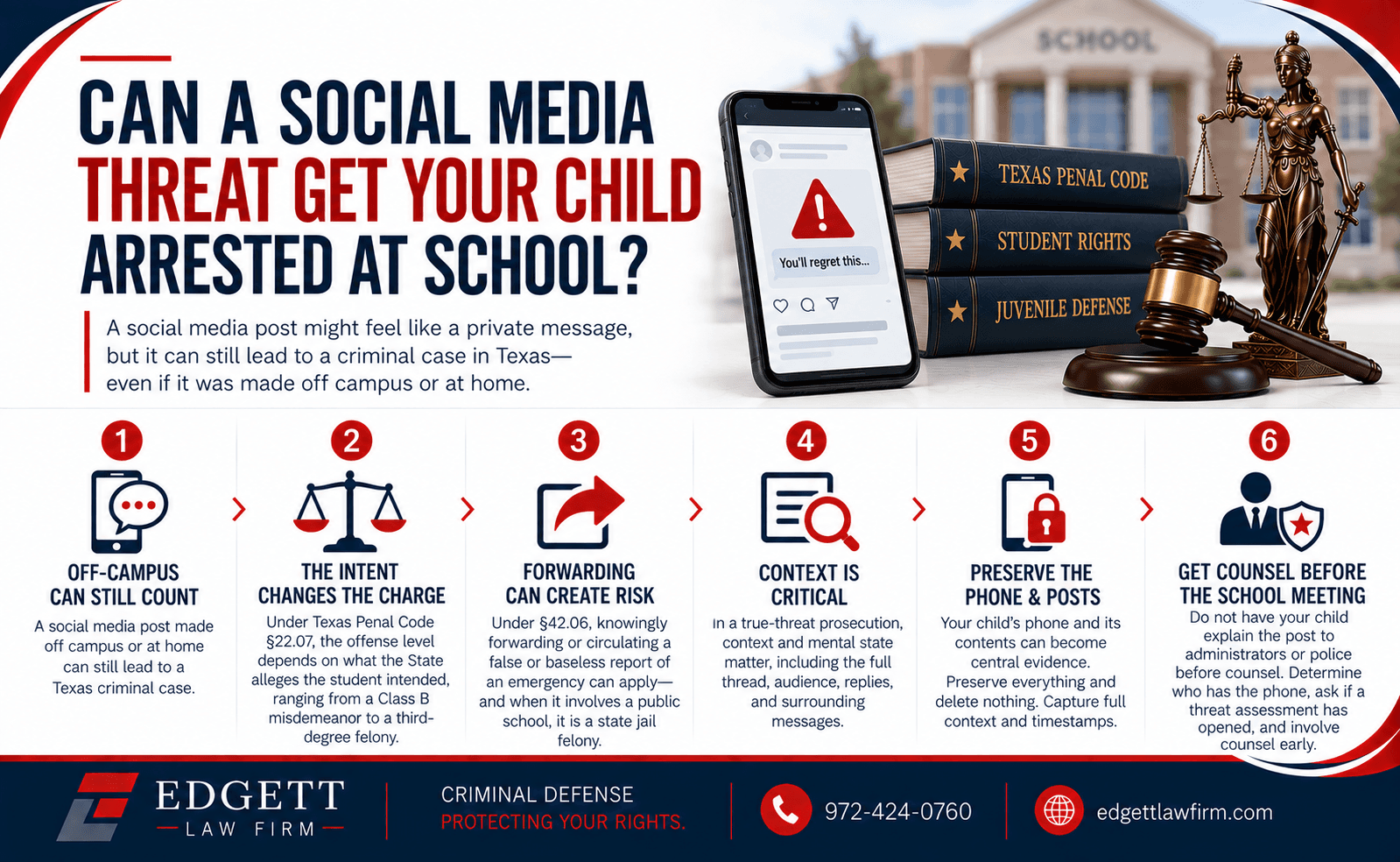
A student posts something about their school at eleven at night, from their own bedroom, on their own phone. A classmate screenshots it. By first period there are officers on campus, a parent is being called, and a phone is being taken.
Almost every parent's first question is whether that can be a crime at all, given the post was made at home. It can. Texas does not ask where the post came from. It asks what the person intended to happen next — and the answer to that question is the difference between a Class B misdemeanor and a third degree felony.
Off Campus Is Not Out of Reach
There are two separate authorities in play, and families routinely collapse them into one.
The school's authority over off-campus speech is limited. In Mahanoy Area School District v. B.L., 594 U.S. 180 (2021), the Supreme Court held that a district violated a student's First Amendment rights by punishing her for a profane Snapchat post made off campus on her own phone. But the Court went out of its way to list the off-campus conduct schools may still regulate, and the first items on that list were serious or severe bullying or harassment aimed at particular individuals, and threats aimed at teachers or other students.
The State's authority is a different matter entirely, and Mahanoy does not touch it. A criminal threat is not student speech that a district is disciplining. It is an offense under the Penal Code, and where it was typed has no bearing on whether it was committed.
Section 22.07 Grades the Threat by What It Was Meant to Do
Section 22.07 of the Penal Code defines terroristic threat. The conduct element is the same across the whole statute — threatening to commit any offense involving violence to any person or property. What changes the offense level is the intent behind it.
| What the State says your child intended | Subsection | Offense level |
| To cause a reaction by an emergency agency — police, fire, EMS | 22.07(a)(1) | Class B misdemeanor |
| To place a particular person in fear of imminent serious bodily injury | 22.07(a)(2) | Class B misdemeanor, or Class A against a family or household member or a public servant |
| To prevent or interrupt the use of a building or place the public has access to — closing the campus | 22.07(a)(3) | Class A misdemeanor, or a state jail felony where the owner suffers pecuniary loss of $1,500 or more |
| To place the public or a substantial group of the public in fear of serious bodily injury | 22.07(a)(5) | Felony of the third degree |
Read down that table and the pattern is unmistakable. A post aimed at one person is charged at the bottom of the range. A post that reads as aimed at the school population is charged at the top. The wording that makes a threat sound general rather than personal — naming no one, referring to the campus as a whole — is the wording that moves it toward Section 22.07(a)(5) and a third degree felony.
The $1,500 figure in Section 22.07(a)(3) also deserves a second look. It sounds like a high bar until you consider what it measures. A district that evacuates a campus, cancels a day of instruction, and pays for an extra police presence does not have to work hard to document that much loss.
The False Report Statute Is the One Parents Miss
There is a second offense that does not require any threat at all, and it catches a category of student conduct that terroristic threat does not: the rumour, the prank, and the repost.
Under Section 42.06 of the Penal Code, a person commits an offense by knowingly initiating, communicating or circulating a report of a present, past, or future bombing, fire, offense, or other emergency that they know is false or baseless and that would ordinarily cause action by an official or volunteer agency organized to deal with emergencies. The base offense is a Class A misdemeanor. It becomes a state jail felony where the false report involves a public primary or secondary school.
Note the verb list: initiates, communicates, or circulates. A student who did not write the original post, believed none of it, and forwarded it to warn friends has still circulated it. Intent to frighten anyone is not an element. That is why a single invented rumour about a campus can produce several separate cases, only one of which involves the student who made it up.
The State Now Has to Prove What Your Child Was Thinking
This is the most useful development in this area in years, and it is recent enough that plenty of people have not caught up with it.
In Counterman v. Colorado, 600 U.S. 66 (2023), the Supreme Court held that the First Amendment requires proof of a subjective mental state in true-threats prosecutions. It is not enough that a reasonable person would have read the words as threatening. The State must show the speaker consciously disregarded a substantial risk that the communication would be viewed as threatening violence — recklessness, at a minimum.
For a teenager's post, that is a real issue rather than a technicality. Adolescent online speech is saturated with exaggeration, in-jokes, song lyrics, game references and copied formats. Whether a particular fifteen-year-old consciously disregarded the risk that a particular post would be read as a genuine threat of violence is a question about that child, in that context, with that audience. It is not answered by reading the sentence aloud in a courtroom.
It also makes the surrounding material matter enormously — the thread the post sat in, what was said immediately before and after, who the audience actually was, and whether anyone in it reacted as though a real threat had been made. Which is precisely the material that gets lost when a screenshot is passed around without its context.
The School Moves Before the Court Does
By the time a charging decision is made, the school process is usually well underway. Anyone who has read our guide to what happens when a child is arrested at school will recognise the pattern, and it is sharper here because the school does not need a charge to act.
Under Section 37.115 of the Education Code, every district must establish a threat assessment and safe and supportive school team to serve at each campus. The statute's definition of harmful, threatening, or violent behavior expressly includes verbal threats and cyberbullying. Where the team determines a student poses a serious risk of violence to self or others, it must immediately report that determination to the superintendent, who then attempts to notify the parent.
House Bill 6, passed by the 89th Legislature in 2025, tightened the referral end of that process: a campus behavior coordinator must report to the Safe and Supportive Schools Program team any student who engages in conduct containing the elements of terroristic threat, unlawfully carrying a weapon, prohibited weapons, or exhibiting, using, or threatening to use a firearm.
The consequence is that a threat assessment can be opened, a risk determination made, and a removal proposed on the school's own timeline, using the school's own standard, well before anyone in the justice system has decided whether an offense occurred. Both proceedings then run at once, and what is said in the first one does not stay there.
The Phone Is the Case
In practice the investigation is an investigation of a device. Officers will want the phone, and what is on it will drive everything else — the original post, the drafts, the thread, the group chats, the search history, and whatever was sent after the first screenshot started circulating.
Because of the way campuses now handle devices, the phone is frequently already in the school's hands when the question of a search arises. We cover that specific problem in our article on the Texas school phone ban and what it means legally. The short version is that consent given quickly, by a frightened student or a cooperative parent, closes off arguments that would otherwise have been available.
The same goes for explanations. The instinct to establish straight away that it was a joke is completely understandable and almost always counterproductive: it concedes authorship, it concedes that the words were sent, and it converts the case into an argument about intent conducted on the State's timetable rather than yours. Our guide to the pre-charge window explains why that stage matters so much.
What to Do in the First 48 Hours
- Preserve everything, and delete nothing. Deleting a post does not remove it — screenshots already exist — and it creates a separate and far worse problem. Keep the account intact.
- Capture the context while it exists. The full thread, the replies, the group it was posted to, and the timestamps. Threads get deleted by other people, and context is the defense.
- Do not let your child explain it to anyone. Not to administrators, not to an officer, not in a written statement, and not in the group chat.
- Ask who has the phone and under what authority. Whether it was handed over, confiscated, or searched, and whether anyone consented, are questions that need answering now rather than later.
- Find out whether a threat assessment has been opened. Ask in writing, and ask for the timeline and the proposed placement.
- Get counsel involved before the school meeting. That meeting will happen first, and it generates a record.
What This Means for Your Family
A post made from a bedroom can still be a Texas offense, and the grade of that offense turns on what the State says your child meant by it rather than on where they were sitting. Between Section 22.07 and Section 42.06 the range runs from a Class B misdemeanor to a third degree felony, and the same set of facts can support very different charges depending on how the intent is characterised. Counterman gives the defense a real foothold on exactly that question, but only if the context survives long enough to be used.
Handled early, these cases often resolve through deferred prosecution or a disposition that keeps a child's record intact — and what that record means later is set out in our article on how Texas juvenile records actually work. If your child is under investigation over something posted about a school in Collin or Denton County, our juvenile defense lawyers can be involved before the first interview. Contact us for a free consultation.
Frequently Asked Questions
Can my child be charged for a threat posted from home rather than at school in Texas?
Yes. Section 22.07 of the Penal Code contains no location element. The offense is threatening to commit an offense involving violence with one of the intents listed in the statute, and it makes no difference whether the threat was made on campus, at home, or anywhere else. The separate question of whether the school may discipline a student for off-campus speech is governed by Mahanoy Area School District v. B.L., 594 U.S. 180 (2021), which left schools able to regulate off-campus threats aimed at teachers or other students.
When is a school threat a felony in Texas rather than a misdemeanor?
It depends on the intent the State alleges. Under Section 22.07(e), a threat made with intent to place the public or a substantial group of the public in fear of serious bodily injury is a felony of the third degree. A threat made with intent to prevent or interrupt the use of a building is a Class A misdemeanor under Section 22.07(d), which becomes a state jail felony where the owner suffers pecuniary loss of $1,500 or more.
Can my child be charged for forwarding someone else's threat in Texas?
Potentially, under a different statute. Section 42.06 of the Penal Code covers a person who knowingly initiates, communicates or circulates a report of a bombing, fire, offense, or other emergency that they know is false or baseless and that would ordinarily cause action by an emergency agency. Circulating is enough, so forwarding can qualify. The offense is a Class A misdemeanor, and a state jail felony where the false report involves a public primary or secondary school.
Does it matter that my child was joking?
It matters to the element the State has to prove, though not as a standalone defense. In Counterman v. Colorado, 600 U.S. 66 (2023), the Supreme Court held that a true-threats prosecution requires proof that the speaker consciously disregarded a substantial risk that the communication would be viewed as threatening violence. An objective reading of the words alone is not sufficient. That makes the surrounding context, audience and thread genuinely important evidence.
Can the school remove my child before any charge is filed in Texas?
Yes. Under Section 37.115 of the Education Code, every district must maintain a threat assessment and safe and supportive school team at each campus, and its definition of harmful, threatening, or violent behavior includes verbal threats and cyberbullying. Where the team determines a student poses a serious risk of violence to self or others, it must immediately report that to the superintendent. That process runs on the district's timeline and does not wait for a charging decision.
Should my child explain the post to school administrators?
Not before speaking to a lawyer. An explanation concedes authorship and transmission, which are the parts of the offense the State would otherwise have to prove, and it converts the case into an argument about intent conducted on a record your child created. School statements are routinely shared with law enforcement, and the school proceeding usually concludes before the court case does.