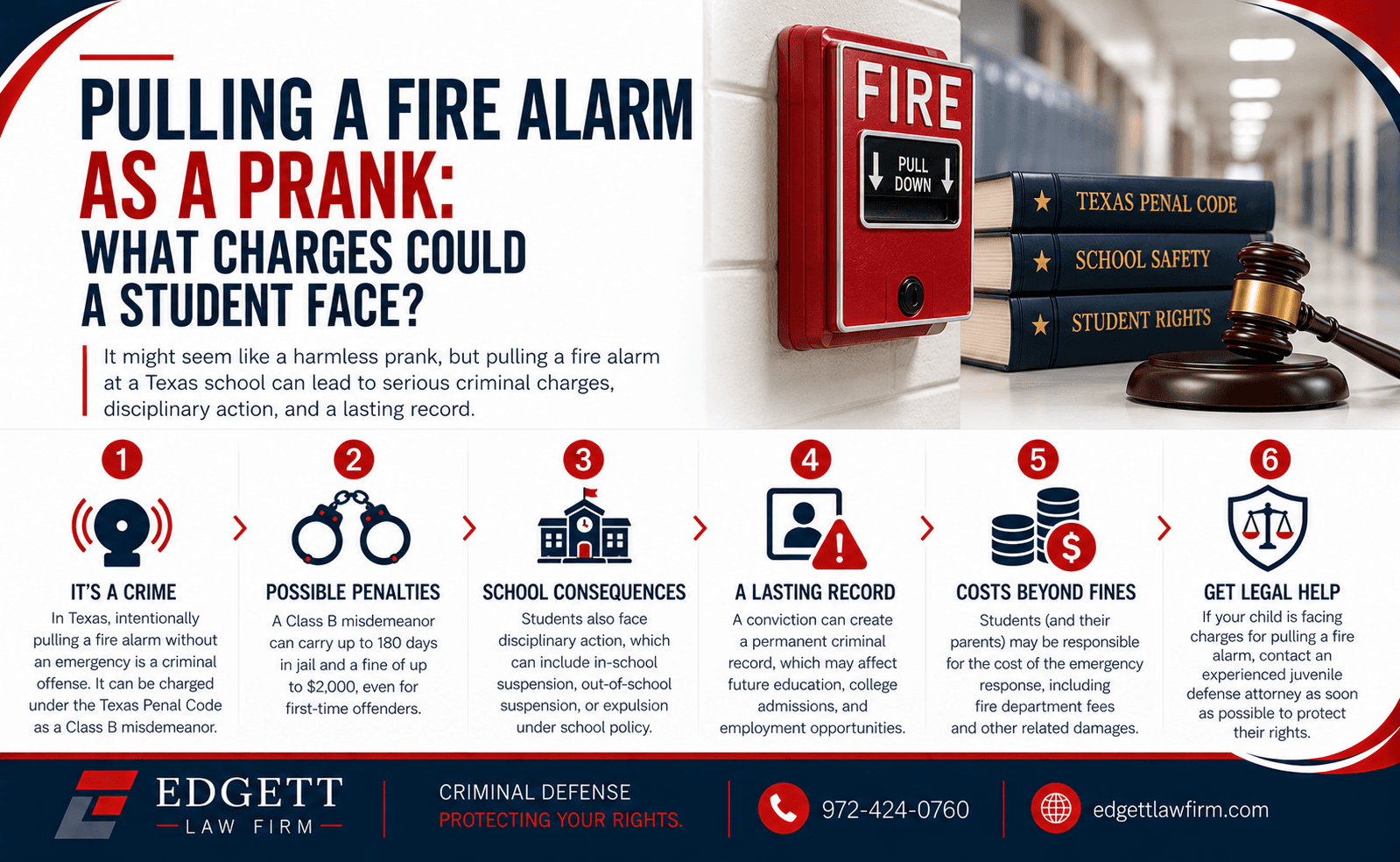
Of all the things a student can do at school on impulse, pulling a fire alarm has the widest gap between how it feels and how it is charged.
It feels like a prank. Everyone files outside, a test gets pushed to Thursday, and the building reopens within the hour. Under Texas law it is a state jail felony — and the criminal case is only the first of three separate consequences, the last of which arrives at the parents' address.
The Statute Does Not Care That It Was a Prank
The offense is in Section 42.06 of the Penal Code, false alarm or report. A person commits it by knowingly initiating, communicating or circulating a report of a present, past, or future bombing, fire, offense, or other emergency that is false or baseless and that would ordinarily cause action by an official or volunteer agency organized to deal with emergencies, place a person in fear of imminent serious bodily injury, or prevent or interrupt the occupation of a building or place of assembly.
Work through those elements against a pulled alarm and every one of them is satisfied without any effort. Pulling the handle initiates a report of a fire. The student knows there is no fire, so the report is false. It is the kind of report that ordinarily brings a fire department response, and it empties a building.
What the statute never asks about is motive. There is no element requiring that the student intended harm, intended to frighten anyone, or intended anything beyond getting out of fourth period. Intending it as a joke is not a defense, because seriousness is not an element.
Why the School Is What Makes It a Felony
Section 42.06(b) sets the base offense at a Class A misdemeanor. It then raises the offense to a state jail felony where the false report involves a public or private institution of higher education, a public primary or secondary school, public communications, public transportation, public water, gas, or power supply, or other public service.
That list is the whole ballgame. The identical act — the same handle, the same student, the same absence of any fire — is a misdemeanor in a shopping centre and a felony in a high school. Location is not an aggravating factor a prosecutor argues for at sentencing. It is written into the grade of the offense.
A state jail felony carries, for an adult, confinement of not less than 180 days and not more than two years and a fine of up to $10,000. A student under 17 is handled in juvenile court, where that range does not apply directly — but the felony grade still drives what the petition alleges, what the school may do about it, and what remains on the record afterwards. Our comparison of juvenile court and adult court covers where that line falls, and it matters here: a 17-year-old who does this is an adult defendant.
The same statute reaches a category of conduct that looks quite different on the surface but sits in exactly the same place legally — the invented rumour about a campus emergency, which we cover in our article on online threats about Texas schools. The word "circulates" in Section 42.06 is what connects them.
The Second Charge Nobody Expects
A false alarm case frequently carries a companion charge, and it is the one that catches families who assume no damage means no case.
Section 28.03 of the Penal Code makes it criminal mischief to intentionally or knowingly tamper with the tangible property of the owner and thereby cause pecuniary loss or substantial inconvenience. That second branch requires no damage at all. Under Section 28.03(b), the offense is a Class C misdemeanor where there is no pecuniary loss but substantial inconvenience is caused, and it climbs with the loss figure from there — Class B at $100, Class A at $750, and a state jail felony at $2,500.
A pull station that has to be reset and recertified, a fire department response, an alarm company callout, and a couple of hundred students out of instruction for the better part of an hour is not a difficult case to describe as substantial inconvenience, and not always a difficult one to price.
The Referral Happens Whether or Not the School Acts
The school track runs in parallel, and Chapter 37 of the Education Code names this conduct specifically rather than leaving it to the general felony rules.
Under Section 37.007(b)(1), a student may be expelled for conduct involving a public school that contains the elements of false alarm or report under Section 42.06 of the Penal Code, or terroristic threat under Section 22.07. Expulsion there is discretionary — the district decides.
Where criminal mischief is alleged, Section 37.007(f) adds something sharper. A student who engages in conduct containing the elements of criminal mischief may be expelled at the district's discretion if the conduct is punishable as a felony under Section 28.03 — and the statute goes on to require that the student be referred to the authorized officer of the juvenile court regardless of whether the student is expelled.
That is worth reading twice. A decision by the district not to expel does not close the matter. The referral is required either way. Families who leave a discipline meeting believing the school has dealt with it leniently are sometimes surprised weeks later, for exactly this reason. The general pattern of the two tracks is set out in our guide to what happens when a child is arrested at school.
The Bill Arrives at the Parents' Address
There is a third consequence, and it is civil rather than criminal.
Under Section 41.001 of the Family Code, a parent is liable for property damage caused by the negligent conduct of their child where that conduct is reasonably attributable to the parent's negligent failure to exercise control and discipline over the child, and for the wilful and malicious conduct of a child who is at least 10 and under 18. Section 41.002 limits recovery for wilful and malicious conduct to actual damages not exceeding $25,000 per occurrence, plus court costs and reasonable attorney's fees.
The cap is not the point. The point is that a claim for the cost of the response, the reset, and the district's losses runs against the parents directly, independently of what happens in juvenile court, and on its own schedule. Court costs and attorney's fees sit on top of the $25,000, not inside it.
Where the Defense Actually Lives
Because motive is not an element, the arguments that matter in these cases are narrower than parents expect — and more often decisive.
- Identity. Far more of these cases turn on who pulled the handle than on what happened afterwards. A crowded hallway, a camera angle that covers the corridor but not the station, and a name supplied by another student under pressure add up to a genuinely contestable question.
- Knowledge. Section 42.06 requires that the report be initiated knowingly and be false or baseless. A student who smelled smoke, saw something they believed was a fire, or was told there was one has not knowingly initiated a false report, even if they were wrong.
- Whether it was voluntary at all. Being shoved into a pull station, or pressured into it in a way that is captured on video or in messages, is a materially different case from the one in the incident report.
- The loss figure. On a criminal mischief count, the pecuniary loss claimed sets the offense level. It is an assertion by the district until it is documented, and it is worth testing.
What to Do in the First 48 Hours
- Do not let your child give a statement or write an apology. An apology concedes identity and knowledge, which are the two things the State actually has to prove.
- Find out precisely what is alleged. False alarm under Section 42.06, criminal mischief under Section 28.03, or both — and whether a referral has already been made.
- Ask what the loss figure is and how it was calculated. Request it in writing.
- Ask what video exists and how long it is retained. Campus footage is frequently overwritten within weeks, and it is as likely to help as to hurt.
- Preserve your child's messages from that day. Group chats often establish pressure, timing, or that someone else did it.
- Do not resolve the discipline hearing first. Under Section 37.007(f) the juvenile referral is required regardless of the outcome, so conceding at the school buys nothing and creates a record.
- Get counsel before either meeting. Both move quickly.
What This Means for Your Family
This is the clearest example in juvenile practice of conduct whose legal weight bears no relation to how it felt at the time. A moment's impulse in a hallway produces a felony-grade allegation, a discretionary expulsion, a mandatory referral, and a civil claim against the parents — none of which depends on anyone having been hurt or anything having been broken.
Addressed early, cases like this are often strong candidates for deferred prosecution or a disposition with no finding of delinquent conduct, which is what determines whether anything survives afterwards — see our article on how Texas juvenile records actually work. If a court date has already been set, our guide to preparing for your child's court date covers what to expect. If your child is facing a false alarm or criminal mischief allegation from a school in Collin or Denton County, our juvenile defense lawyers can be involved before the referral is acted on. Contact us for a free consultation.
Frequently Asked Questions
Is pulling a fire alarm at school a felony in Texas?
Yes, at a public school it is charged as a state jail felony. Section 42.06 of the Penal Code makes it an offense to knowingly initiate, communicate or circulate a report of a fire or other emergency that is false or baseless and that would ordinarily cause action by an emergency agency. Section 42.06(b) sets the base offense at a Class A misdemeanor but raises it to a state jail felony where the false report involves a public primary or secondary school or an institution of higher education.
Does it matter that my child meant it as a joke?
Not to the elements of the offense. Section 42.06 requires that the report be initiated knowingly and be false or baseless. It contains no element of intent to harm, intent to frighten, or seriousness of purpose. What the student meant by it may matter to a prosecutor's charging decision or to disposition, but it is not a defense to the offense itself.
Can my child face a second charge if nothing was damaged?
Yes. Section 28.03 of the Penal Code makes it criminal mischief to intentionally or knowingly tamper with another's tangible property and cause pecuniary loss or substantial inconvenience. The substantial inconvenience branch requires no damage at all. Under Section 28.03(b), that is a Class C misdemeanor where there is no pecuniary loss, rising to a Class B at $100, a Class A at $750, and a state jail felony at $2,500.
Will my child be expelled for pulling a fire alarm in Texas?
It is discretionary rather than automatic. Section 37.007(b)(1) of the Education Code permits a district to expel a student for conduct involving a public school that contains the elements of false alarm or report under Section 42.06. Where criminal mischief is alleged, Section 37.007(f) permits expulsion if the conduct is punishable as a felony and separately requires that the student be referred to the authorized officer of the juvenile court regardless of whether the student is expelled.
Can parents be sued for what their child did at school in Texas?
Yes. Section 41.001 of the Family Code makes a parent liable for property damage caused by a child's negligent conduct where it is reasonably attributable to the parent's negligent failure to exercise control and discipline, and for the wilful and malicious conduct of a child at least 10 and under 18. Section 41.002 limits recovery for wilful and malicious conduct to actual damages not exceeding $25,000 per occurrence, plus court costs and reasonable attorney's fees.
What defenses are available to a false alarm charge in Texas?
The most common are identity and knowledge. Many of these cases rest on which student pulled the station in a crowded hallway, which camera coverage and witness accounts may not resolve. Section 42.06 also requires that the report be made knowingly and be false or baseless, so a student who believed there was a fire, or who was told there was one, has not knowingly initiated a false report. On an accompanying criminal mischief count, the pecuniary loss figure sets the offense level and can be tested.